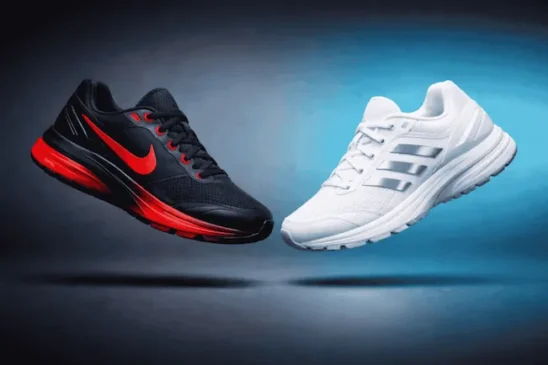


Nike vs Adidas running shoes in 2026: a model by model look at fit, cushioning, stability, sizing and price, to help you match the right pair to your foot.
Key Takeaways
- Nike suits narrow feet and a snug fit; Adidas offers a roomier toe box.
- Adidas has the cheaper starter shoe, the Duramo SL 2, at around $70.
- Only Nike makes a dedicated stability shoe; the Structure 26 costs about $145.
- Compare foot length rather than shoebox numbers, since the brands differ mainly in UK labels.
Nike vs Adidas running shoes in 2026: compare fit, sizing, cushioning, price, and durability, with model by model matchups to help you pick the right pair.
Ask a runner what separates Nike from Adidas and you’ll still hear about Boost foam. That answer is out of date. Lightstrike and Lightstrike Pro have replaced Boost across Adidas’s current performance running line, and Nike has rebuilt its own range around redesigned shoes like the Pegasus 42 and the Structure 26.
The sales figures show how much changed. Adidas says its running business had accelerated to more than 30% growth by the end of 2025, led by the Adizero line, with double digit currency neutral growth in every market it sells in. Nike CEO Elliott Hill told investors on the fiscal 2026 fourth quarter call that Nike Running had posted five straight quarters of double digit growth and added roughly $1 billion to the category. What follows covers fit, cushioning, stability, sizing, and price, plus five model matchups that show where each brand actually wins.
Quick answer

- A narrow, locked in fit: Nike
- A roomier toe box: Adidas
- The best budget pick: Adidas, with the Duramo SL 2 at around $70
Nike vs Adidas: The Short Answer for Runners
Neither brand wins for everyone. Marathon Handbook lands in the same place, and it holds up once you look at real shoes. Both brands make solid neutral trainers, racers, and trail shoes. What separates them is how the shoe wraps your foot and what it costs at the edges of the lineup. So is Nike better than Adidas? For a snug fit, often. Is Adidas better than Nike? For toe room and a cheap starter shoe, often. The nike or adidas choice mostly comes down to four things:
- Nike suits runners who want a snug, locked in fit.
- Adidas gives you more toe room.
- Adidas has the cheaper entry level shoes.
- Nike’s Pegasus is the pick if you want one well rounded daily trainer.
The brand level story beyond running lives in our broader Nike vs Adidas article, so this page stays focused on the shoes.
Where Nike and Adidas Running Stand in 2026
Nike closed fiscal 2026, which ended May 31, 2026, with revenue of $46.4 billion. Footwear under the Nike Brand brought in $29.5 billion of it. The mix shifted, though. Wholesale revenue rose 6% to $27.5 billion, while Nike Direct, the company’s own stores and app, fell 6% to $17.7 billion. Nike Brand digital sales fell 12% for the year, on top of a 20% drop the year before, which the company ties to slowing organic traffic. That’s a real swing back toward the retail partners who stock several brands side by side.

Adidas reports in euros, and its 2025 revenue hit a record €24.8 billion. Its annual report says running growth kept building through the year and had passed 30% by the end of it, powered by the Adizero family. Adidas also reports double digit currency neutral growth in every market for 2025, ranging from 10% in Europe and North America up to 22% in Latin America. Nike is the bigger company by revenue. Past that, the figures don’t compare cleanly, since the currencies and the years differ, so be wary of anyone who builds a market share percentage out of them. For runners, the headline isn’t the size of either company. Both are pushing hard on running right now, which is why 2026 lineups look so different from the ones in older comparisons.
Nike vs Adidas Running Shoes Comparison at a Glance
Here’s the short version, side by side.
| Nike | Adidas | |
| Fit and width | Narrower toe box in the Pegasus and Vomero | Roomier toe box in the Ultraboost and Boston line |
| Cushioning | ZoomX, ReactX, and Air Zoom | Lightstrike and Lightstrike Pro |
| Upper | Flyknit in many models | Mesh in many trainers |
| Stability | Dedicated Structure 26 with a midfoot support system | No dedicated stability shoe, with support built into the Supernova Rise |
| Race shoes | Vaporfly 4 ($260), plus the Alphafly 3 for the marathon | Adios Pro 4 (around $250) and Adios Pro Evo 3 (around $500) |
| Wide sizes | Pegasus 42 (some colors) and Structure 26 | Supernova Rise 3 |
| Price examples | $145 for the Pegasus 42 up to $260 for the Vaporfly 4 | Around $70 for the Duramo SL 2 up to around $500 for the Pro Evo 3 |
| Lifespan | 300 to 500 miles for daily trainers, commonly cited | 300 to 500 miles for daily trainers, commonly cited |
| Trail | Wildhorse 10 ($165) | Terrex Agravic Speed Ultra 2 (around $230) |
Nike leans toward a snug fit and a dedicated stability shoe. Adidas leans toward toe room and a lower starting price, and it still works with Continental on outsole rubber.
Cushioning and Foam: ZoomX, ReactX, Air Zoom, and Lightstrike Pro
What Nike uses
Nike’s current road shoes lean on three cushioning pieces. The Vomero 18 layers ZoomX, a lighter and bouncier foam, over a ReactX base. In the Pegasus 42, ReactX pairs with a full length Air Zoom unit, an air filled pod that runs the length of the midsole. Heel to toe, the Structure 26 uses ReactX. RunToTheFinish notes that ZoomX’s material (PEBAX) traditionally wears out faster than other foams, and that layering it over ReactX helps offset that.
What Adidas uses
Boost is mostly gone from Adidas’s performance shoes. Lightstrike and Lightstrike Pro have replaced it across the current performance running line, and Boost now lives mainly in lifestyle models like the Ultraboost. Of the two, Lightstrike Pro is the top tier foam. It shows up in the Adizero Evo SL, a daily trainer at about $150. Adidas also sorts its running shoes into four families: Adizero, Supernova, Adistar, and Ultraboost. Adizero is the speed line, Supernova covers comfortable, supportive daily miles, and Ultraboost leans toward lifestyle, balancing cushioning, energy return, durability, and style.
What it feels like underfoot
The Vomero 18 is the plush one, built for easy days and long runs. The Evo SL sits at the other end: RunToTheFinish describes it as not as bouncy as a carbon plated racer and not as soft as a daily trainer, which makes it a firmer ride than the Vomero if you’re coming from something plush. Between them sits the Pegasus 42. It isn’t max cushion and it isn’t a speed shoe, but it can pick up the pace. Foam names matter less than the feel, so if you can try a soft shoe and a snappy one back to back, do it.

Stability and Pronation Support
Nike’s Structure 26 is its dedicated stability shoe. Instead of a rigid post, it uses a midfoot support system, an arch wrap plus an internal support band, to guide your foot. RunToTheFinish says it replaced the Invincible line as Nike’s stability series.
- A 38mm stack and a 10mm drop
- A price of about $145
- A wide version for broader feet
Adidas doesn’t have a direct match. Its lineup leans neutral, with some support built into shoes like the Supernova Rise rather than a standalone stability model. The Duramo SL 2 sometimes gets framed as the Adidas answer, but it’s a neutral budget trainer.
No shoe will “fix” overpronation, either. RunToTheFinish’s Amanda Brooks says she isn’t a fan of stability shoes for most runners, since they’re built around preventing foot roll and often feel more rigid as a result. If you think you need pronation support, a gait check at a specialty running store will tell you more than any label on a box.
Nike vs Adidas Size: Does Adidas Run Bigger Than Nike?
Sizing advice online contradicts itself, so here’s what holds up and what doesn’t.
The charts actually agree more than they appear to
Both brands print two different kinds of number on their size charts, and mixing them up is what causes most of the confusion. Nike’s chart lists a “CM/JP” figure of 28 for a men’s US 10, but that’s a shoebox style last measurement, not your foot length. Nike’s own chart gives the actual recommended foot length for that same US 10 as 27.1cm. Adidas’s chart works the same way, and its foot length figure for a men’s US 10 is also 27.1cm. Once you compare foot length to foot length instead of shoebox number to foot length, the two brands agree at US 10.
Where they genuinely diverge is the UK label: Nike calls a men’s US 10 a UK 9, while Adidas calls the same US size a UK 9.5. That half size gap is real, confirmed on both brands’ own charts, and it’s a better reason to double check your size when switching brands than any myth about the centimeters not matching.
Does Nike really run small?
The evidence is mixed. Some sources say Nike runs small and narrow. Others say Nike is true to size and Adidas is the one that runs short. Specialist reviewers land in the middle: complaints about length are inconsistent, while complaints about width are steady. Much of what gets called “running small” is a narrow toe box squeezing your toes in a shoe that’s the right length. That’s why the habit of buying a half size up is shaky. If width is the problem, a longer shoe leaves your toes just as cramped and gives your heel room to slip. Treat it as a width question, not a length question.
Width and toe box: where the real difference shows up
Nike’s Pegasus and Vomero measure narrower through the toe box. Adidas’s Ultraboost and Boston line measure roomier, and that’s backed by reviewers who put calipers on the shoes, not just by impressions. If your toes splay out or you sit between widths, this gap matters more than length. Wide foot runners shouldn’t write off either brand yet, though, because the next section shows which models come in wide.
Models that come in wide
| Shoe | Wide option |
| Nike Pegasus 42 | Yes, in some colors |
| Nike Structure 26 | Yes |
| Adidas Supernova Rise 3 | Yes |
| Nike Vomero 18 | No |
| Nike Vaporfly 4 | No |
| Adidas Adios Pro 4 and Adizero Adios Pro Evo 3 | No |
New Balance tends to have the biggest selection of wide and extra wide widths among the major running brands, so it’s worth a look if neither Nike nor Adidas fits. Stock changes often, so check the product page for width options before you order.
Nike vs Adidas Running Shoe Reviews: Model Matchups
Here’s how Nike and Adidas running shoes shake out when you compare actual models. Specs and prices come from Nike’s and Adidas’s own product pages and independent reviewers, including Doctors of Running, Fleet Feet, WearTesters, iRunFar, RoadTrailRun, and RunToTheFinish, checked in October 2026. Weights are for men’s sizes. Where the two brands don’t have a true like for like shoe, the section says so instead of forcing a pair. Prices move, so read them as a snapshot.
Daily trainer: Pegasus 42 vs Supernova Rise 3
The Pegasus 42 costs $145, weighs about 10.6oz, and stacks 37mm of midsole in the heel and 27mm in the forefoot, with a 10mm drop. It pairs ReactX with a full length Air Zoom unit, and it comes in wide in some colors. The Supernova Rise 3 runs about $140, weighs 9.3oz, drops 8mm, and also comes in wide.
So which one? Mostly your toe box. RunToTheFinish calls the Pegasus a durable, fairly priced daily trainer that isn’t max cushion and isn’t a speed shoe, though it can pick up the pace. The Supernova Rise 3 is cushioned but not max cushion either, and the same reviewer positions it as a shoe that can work from easy days through speed sessions. With both shoes in the same price band, the choice comes down to shape and feel, not money.
Long runs: Vomero 18 vs Adizero Evo SL
The Vomero 18 is $155, weighs about 11.5oz, and has a 10mm drop, with ZoomX layered over ReactX. The Adizero Evo SL runs about $150, weighs roughly 8oz, drops 6mm, and uses Lightstrike Pro through the full midsole.
They aren’t really rivals. The Vomero is a plush shoe for easy days and long runs. The Evo SL is firmer, sitting between a carbon racer’s snap and a daily trainer’s softness, which leans it toward tempo work. With prices this close, pick by what you want the shoe to do, not by the tag. If you’re coming from very soft shoes, the Vomero will feel familiar sooner than the Evo SL will.
Stability: the Structure 26 has no direct Adidas match
The Structure 26 costs about $145, stacks 38mm in the heel and 28mm in the forefoot with a 10mm drop, uses a midfoot support system, and comes in wide. Adidas doesn’t currently sell a dedicated stability shoe, so there’s no honest head to head here. The Duramo SL 2 gets pitched as the Adidas option now and then, but it’s a neutral budget trainer. If you want Adidas and need some support, look at what the Supernova Rise builds in, and get a gait check first.
Race day: Vaporfly 4 vs Adidas’s Adios Pro line
The Vaporfly 4 is $260, weighs 6.7oz, drops 6mm, and doesn’t come in wide. It suits distances from 5K up to the half marathon. For the full marathon, Nike points runners to the Alphafly 3. RunToTheFinish describes a narrow, on rails feel, and says the outsole still raises durability questions.
Adidas has two answers. The Adizero Adios Pro 4 is the mainstream numbered racer, at around $250. At the top, the Adizero Adios Pro Evo 3, released in April 2026, is the ultra premium flagship. It weighs under 100 grams (about 3.4oz), costs around $500, and replaces the Evo 2 that older reviews still describe. Its stack is 39mm in the heel and 36mm in the forefoot with a 3mm drop, and it runs on Lightstrike Pro Evo foam with Continental rubber across the forefoot. Reviewers describe it as a shoe built for a single peak race, not for stacking miles.
Trail: Nike’s Wildhorse 10 vs Adidas Terrex Agravic Speed Ultra 2
The Wildhorse 10 costs $165, weighs about 11oz in a men’s size 10, and pairs a ReactX midsole with Nike’s All Terrain Compound outsole. Nike’s own product page rates it for “less to moderately technical” terrain, which is Nike’s own classification, not a reviewer’s guess. Independent reviewers don’t fully agree on how far that stretches in practice: iRunFar calls it capable on technical, rocky courses up to 100K, while RunToTheFinish and RoadTrailRun describe it as better suited to mid level or moderately technical trails rather than a true technical specialist. Both views are worth knowing before you buy. If you want something gentler, the Pegasus Trail sits lower on Nike’s own terrain scale, rated simply “less technical.”
Adidas’s current pick is the Terrex Agravic Speed Ultra 2, at around $230. The older Agravic Ultra, which sold for $130, is no longer made, so ignore guides that still list it.
Which Is Cheaper, Nike or Adidas?
At the daily trainer level it’s close to a draw. Adidas wins at the bottom, and the top of the range is where things get interesting. Skip any brand wide average you find online. Those figures tend to come from older models, and model level prices tell the story better.
- Daily trainers: the Supernova Rise 3 is about $140, the Pegasus 42 is $145, the Evo SL is about $150, and the Vomero 18 is $155.
- Budget: the Adidas Duramo SL 2 is around $70.
- Premium: the Vaporfly 4 is $260, the Adios Pro 4 is around $250, and the Pro Evo 3 is around $500.
Nike and Adidas race shoes are nearly level until you reach the Pro Evo 3, which costs almost twice the Vaporfly 4. Availability matters there too. Adidas launched it in limited pairs in April, with a wider release planned for the autumn marathon season. One tip for the rest of the lineup: last season’s models are routinely discounted at both brands.
How Long Do Nike and Adidas Running Shoes Last?
Shoe life is a range, not a number, and durability depends as much on the runner as the shoe. Both brands are commonly cited at the same mileage for daily trainers, while racing shoes wear faster.
- Daily trainers from both brands are commonly cited at 300 to 500 miles.
- Race shoes like the Vaporfly are commonly cited at 200 to 300 miles.
- Body weight, running style, terrain, and how often you rotate shoes all change the real number. RunToTheFinish puts it simply: it depends on your gait, your weight, and whether you mostly run on trail or road.
- Peak race shoes like the Pro Evo 3 are built for one big day, not for stacking miles.
These are commonly cited figures, not independent lab results.
Which Brand Fits Which Runner?
Is Nike better than Adidas? And is Adidas better than Nike? Both questions have the same honest answer: your foot comes first, your runs second, and your budget a distant third.
Foot shape
- Choose Nike if you have a narrow foot and like a snug, locked in feel.
- Choose Adidas if your toes need room, since the Ultraboost and Boston line measure roomier.
- Need wide? The Pegasus 42, Structure 26, and Supernova Rise 3 all come in wide, and for very wide feet, New Balance is worth checking.
Type of run
- For one shoe that does everything, start with the Pegasus 42, or the Supernova Rise 3 if you want more room.
- For support, look at the Structure 26 after a gait check at a specialty running store.
- For race day, the Vaporfly 4 covers up to the half marathon, while Adidas offers the Adios Pro 4 and Pro Evo 3.
Budget
- The Duramo SL 2, at around $70, is the cheapest way into either brand.
- Daily trainers cost about the same, so decide on fit rather than price.
Still split? Match the shoe to the problem you’re solving. Cramped toes point to Adidas, or to a wide Nike. A loose, sloppy feel points to Nike’s snugger shape. And on race day, both brands have a flagship worth the money, if you can find it in your size.
Return Policies and How to Test Fit
Fit is the one thing a chart can’t settle, so the return window counts. Here’s where each brand stands as of October 2026:
- Nike US: 60 days to try a purchase, with free returns for Nike Members.
- Nike UK: 30 days, and the shoes must be unworn.
- Adidas: 30 days across its US, UK, and EU sites.
Policies differ by country, and shoes bought from a third party store go back to that store, under its rules, not the brand’s. Read your own country’s page before you order. Then try the shoes on with the socks you run in, and cover a few short, easy runs while the window’s still open.
How We Checked This Comparison
This comparison draws on Nike’s and Adidas’s own product pages, size charts, and return policy pages, Nike’s 10 K and fiscal 2026 fourth quarter earnings call, Adidas’s 2025 annual report, and independent reviewers including Doctors of Running, Fleet Feet, WearTesters, iRunFar, RoadTrailRun, and RunToTheFinish. The details were checked in October 2026. Shoe notes rest on those reviewers’ published findings, not on in house wear testing. Prices, specs, and stock change often, so confirm them on the product page before you buy.
Nike vs Adidas Running Shoes: FAQs
Which is better, Adidas or Nike?
Neither wins across the board. Foot shape and the kind of running you do decide it far more than the logo. Narrow feet and a snug feel point to Nike, while toe room and a lower starting price point to Adidas. The fit section above breaks it down by runner type.
Is Adidas higher quality than Nike?
There’s no consistent evidence either way. Both brands are commonly cited in the same 300 to 500 mile range for daily trainers, and real quality gaps show up model by model, not brand by brand. A shoe that fits your foot will outlast one that doesn’t, because you’ll keep running in it.
Why choose Adidas over Nike?
Mostly for room and for price. The Ultraboost and Boston line measure roomier through the toe box, the Duramo SL 2 starts at around $70, and the Adizero Evo SL puts Lightstrike Pro foam in a trainer that costs about $150. If none of that matches your needs, the Pegasus 42 is the better all round pick.
What’s more expensive, Nike or Adidas?
At the daily trainer level they’re close, with the models in this comparison landing between $140 and $155. The gap opens at the top. At around $500, the Adios Pro Evo 3 costs nearly double the $260 Vaporfly 4. Lower down, Adidas has the cheaper starter shoe.
Do Nike or Adidas run bigger? Should I size up or down?
Probably not, once you compare the right numbers. At a men’s US 10, both brands’ official charts actually agree on foot length (27.1cm), even though the shoebox style numbers printed alongside (both around 28) can make it look otherwise. The real, confirmed gap is in the UK label: Nike calls a US 10 a UK 9, Adidas calls it a UK 9.5. If your toes feel cramped in either brand, width is a more likely cause than length.
How do I convert my Adidas size to a Nike size?
At the same US number, the two brands’ foot length figures line up closely, so a straight US to US conversion is more reliable than people assume. The UK label is where it breaks down: don’t carry a UK size across brands without checking each one’s own chart, since Nike and Adidas use different UK numbers for the same US size.
What is wider, Adidas or Nike?
Adidas, usually. Its Ultraboost and Boston line measure roomier through the toe box, while Nike’s Pegasus and Vomero measure narrower. Wide options exist for the Pegasus 42, Structure 26, and Supernova Rise 3, but not for the Vomero 18 or the racing shoes.
Which brand is more popular, and who sold more?
Nike is the larger company by revenue, with $46.4 billion in fiscal 2026, while Adidas reported a record €24.8 billion for 2025. Those figures use different currencies and different years, and they cover more than running. They show scale, not a clean running shoe market share.